


You know where all your outlets are. Your customers don’t.
For a retailer, having dozens or even hundreds of locations represents growth. For a shopper, however, those same locations can become dozens of choices they have to sort through.
A basic directory on the home page may show every address, but it still leaves the customer asking one important question: Which store should I actually visit?
That is where an outlet store locator changes the experience.
Instead of making shoppers browse long lists, compare addresses, or open multiple pages, it can help them quickly locate the nearest outlet based on where they are and what they want.
The difference matters because online research increasingly influences physical shopping trips. McKinsey and ICSC’s 2026 consumer research found that convenience-driven shoppers often know what they want before leaving home and use digital channels to research factors such as availability, prices, selection, and offers.
A useful outlet store locator removes friction from that journey. Whether someone wants to shop a particular collection, discover a favorite brand, or simply find an outlet near their current location, the goal is the same: give them a clear path from search to store visit.
In this guide, we’ll explore five strategies for turning a basic location experience into an outlet store locator that does the searching for your customers.
More importantly, you’ll see how smarter outlet discovery can turn online intent into confident visits and real opportunities for your business.
Getting shoppers to your locations starts with recognizing a simple problem: displaying every address is not the same as helping someone choose where to go.
A basic list may work when you have three stores. Once that network grows, the customer is forced to do the work your outlet store locator should be doing for them.
Imagine landing on a retailer’s home page and opening a directory containing 50 outlet stores. You browse by city or state, open several locations, compare addresses, and then check a map to determine which one is closest. That’s a lot of effort for someone who simply wants to shop.
A traditional outlet locator often leaves shoppers to:
A modern outlet finder reverses that experience. Instead of asking, “Which of our 50 stores do you want?”, it starts with the shopper’s location and surfaces the most relevant options.
| Basic Store List | Modern Outlet Store Locator |
| Shows every location | Surfaces relevant nearby locations |
| Requires manual comparison | Uses proximity to narrow results |
| Makes shoppers browse | Lets shoppers search directly |
| Treats every result equally | Prioritizes useful results |
This matters because customers visiting physical stores increasingly begin their journey online. When a near me outlet search leads to a confusing list rather than a clear answer, another retailer is only a search away.
Your customers don’t need to understand how your entire store network is organized. They need an outlet store locator that turns dozens of possibilities into a few useful choices.
The next step is giving them a tool that can do exactly that.
This is where the experience needs to change.
A shopper who is ready to visit shouldn’t have to fight through menus, scan dozens of addresses, or leave your website just to figure out which store is closest.
Every extra step creates frustration. And every moment of frustration gives that customer another reason to choose somewhere easier.
Agile Store Locator, a WordPress plugin, turns that frustrating journey into a simple one.
Instead of presenting shoppers with your entire location network, this WordPress plugin helps them search for the stores that actually matter to them.
A customer can enter a location, use geolocation, explore results on Google Maps, and narrow their choices with categories and filters. Your outlet store locator starts doing the hard work for them.
That means shoppers can quickly:
Think about the difference this creates.
Someone looking to shop a new collection, visit a factory outlet, or compare their favorite brands no longer needs to decode your store network. They can focus on the exciting part: deciding where they want to go and what they want to buy.
For WordPress businesses evaluating how to create this experience, our guide to setting up a store locator plugin for WordPress explains the wider role a locator can play in connecting online visitors with physical stores.
Because every business has different needs, the right solution depends on your locations, search requirements, filters, and customer journey.
An outlet store locator shouldn’t make shoppers think harder. It should make the answer feel obvious.
That’s the real value of a WordPress Store Locator, like Agile Store Locator, turning “Where should I go?” into “That’s the store I need.”
Once that friction disappears, the next challenge is making sure the nearest outlet rises to the top at exactly the right moment.
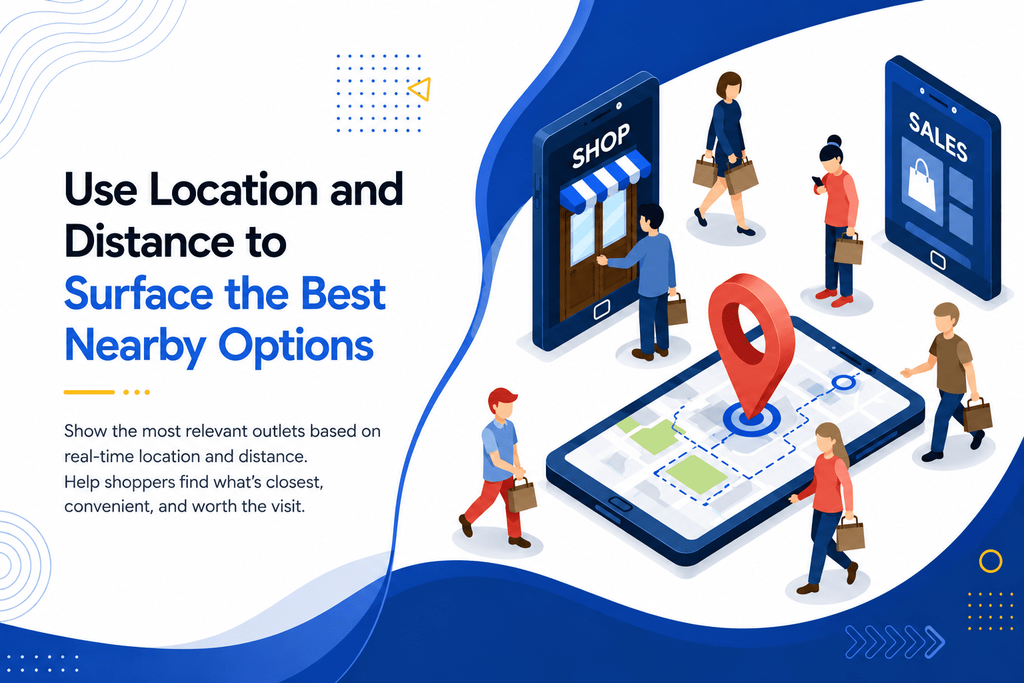
Once shoppers can search your store network easily, the next question is obvious: Which location is closest to me?
A modern outlet store locator should answer that question without making customers compare addresses themselves.
By using geolocation or a search based on city, address, or ZIP/postcode, businesses can quickly surface nearby options and help shoppers identify their nearest outlet.
This is especially valuable for mobile visitors who may already be traveling or planning an outlet shopping trip. Instead of browsing every store, they can focus on the locations within a practical distance.
An effective outlet store locator can help shoppers:
This behavior also reflects how people search online. Someone might search for a near me outlet, while another may use a more specific phrase such as “grocery outlet locations near me”. Despite the different wording, the expectation is similar: show me relevant options close to where I am.
Businesses trying to capture this type of local intent can explore our deeper guide to near me outlet searches and how they connect online discovery with physical visits.
The goal of an outlet store locator isn’t to show shoppers every possible store. It’s to reduce a large network to the few locations worth considering.
But proximity only solves part of the problem. The nearest outlet may be close, yet it still might not carry the brand, collection, or services the shopper wants.
That’s why the next strategy moves from finding the closest outlet to finding the right one.
Finding the closest store is useful, but distance alone doesn’t guarantee the best match.
A shopper may have several locations nearby, but only one carries the brand, product category, or services they actually want.
That’s where a smarter outlet store locator becomes more valuable. Filters can turn a long list of nearby results into a smaller selection built around the shopper’s needs.
For example, one customer might want to shop for Nike or Adidas footwear, while another may be interested in Coach, Tommy Hilfiger, or another popular brand. Instead of opening every store individually, shoppers can narrow the results before deciding where to go.
Useful filters might include:
This is the difference between showing the nearest outlet and showing the right outlet.
A well-designed outlet finder understands that relevance matters just as much as distance.
A grocery outlet locator, fashion outlet locator, or multi-brand shopping center may serve very different customers, but the expectation remains consistent: don’t make people sort through irrelevant choices.
An effective outlet store locator helps shoppers move from “What’s near me?” to “Which place has what I want?”
Once they find that location, however, they need enough accurate information to feel confident getting in the car and making the trip.
That’s where the next strategy becomes essential.
Finding the right store is only half the journey. Before shoppers decide to visit, they want reassurance that the trip will be worth their time.
Imagine driving across town for an exclusive clearance event, only to discover the outlet closed an hour earlier. Or arriving at an outlet mall because an old address or opening time was still displayed online. As a result, one inaccurate detail can turn an excited shopper into a frustrated customer.
A reliable outlet store locator should give shoppers the information they need before they leave home, including:
Accurate information matters because digital trust can influence whether someone completes the journey to a physical store. Uberall’s consumer research highlights accurate opening hours and local information among the signals customers consider when deciding where to visit.
Ultimately, an outlet store locator needs to do more than identify a place on the map. It should give shoppers enough confidence to think, “Yes, this is where I want to go.”
And because many of those decisions happen while customers are already on the move, that confidence needs to translate just as smoothly to a mobile screen.
By the time someone reaches for their phone to find an outlet, they may already be ready to shop. They could be traveling, exploring a new city, or deciding which shopping destination to visit next. Therefore, a slow or awkward mobile experience can interrupt that momentum.
A mobile-friendly outlet store locator should make the journey from search to directions as short as possible. Instead of shrinking a desktop experience onto a smaller screen, the outlet finder should prioritize the actions mobile shoppers need most.
That means making it easy to:
The best mobile experience removes decisions rather than adding them.
A shopper searching for a near me outlet shouldn’t need to zoom around a crowded map, browse an endless directory, or open several pages just to understand what’s nearby.
A responsive outlet store locator keeps search, store details, and directions easy to use on any screen size. That creates a smoother experience for customers whether they’re planning from home or already on the road.
But even the best mobile locator only works once shoppers reach it. The final strategy is making each outlet easier to discover online in the first place.
A great locator solves the discovery problem once shoppers reach your website. But there is another opportunity: helping people discover individual stores while they are still searching online.
Dedicated location pages give every outlet its own digital presence.
Instead of relying on one general directory, each page can provide useful information about a specific store, its address, opening hours, services, and directions. An outlet store locator can then connect these individual pages with the wider search experience.
This matters because online and offline shopping are increasingly connected.
For stronger outlet discovery, businesses should focus on:
This gives customers more ways to discover a retailer, whether they’re looking for a factory outlet, exploring a new shopping destination, or simply trying to locate a store near them.
Businesses that want to take location discovery beyond WordPress can also explore WP Maps, a cloud-based Store and Product Locator app. It allows businesses to display stores alongside the products available at each location, giving shoppers another way to explore where they can find what they want.
A discoverable outlet store locator brings the journey together: shoppers find your locations online, identify the most relevant option, and arrive with greater confidence.
That leaves one final question: does your locator make that journey easier or simply give customers another place to search?
You know where all your outlets are. Your customers shouldn’t have to.
From identifying the nearest outlet and comparing brands to checking opening hours and getting directions, every step should make the decision easier.
A well-designed outlet store locator removes the work from that journey and helps shoppers focus on what matters: choosing where to shop and getting there.
For businesses, that means more than improving a map. It means creating an experience that can:
Your outlet store locator should never feel like another obstacle between a shopper and your stores.
With Agile Store Locator, you can transform a complicated network of locations into a simple path from “Where should I go?” to “That’s the store I need.”
The easier you make that answer to find, the easier you make the next step: the visit.
An outlet store locator is a search tool that helps shoppers find relevant outlet locations based on their address, city, ZIP code, or current location.
Instead of browsing a long store directory, customers can compare nearby options, view important details, and get directions to the outlet they want to visit.
A detailed outlet location experience can provide more than store addresses.
Depending on the information a business chooses to display, shoppers may be able to identify a nearby restaurant, places to dine, services, shopping facilities, and other useful details before planning their visit.
Yes. Businesses can use location information and custom fields to highlight store-specific details, promotions, events, or great savings where applicable.
This can be particularly useful when customers are comparing outlet locations and deciding which one offers the most relevant shopping experience.
Yes. Categories and custom filters can make an outlet store locator useful for shoppers searching for specific brands or types of products.
For example, a customer might be looking for Skechers, Columbia, Clarks, Levi’s, Claire’s, Carter’s, American Eagle, Banana Republic, Gap, Children’s Place, LOFT Outlet, OshKosh, or Bath & Body Works. Instead of browsing every outlet manually, relevant brand filters can help shoppers narrow their choices more quickly.
Yes. An outlet finder can organize stores using categories, subcategories, and other relevant attributes.
A shopper looking for a shoe store, denim, beauty products, bath products, or even a chocolate shop can use relevant filters to reduce unnecessary results and focus on locations that better match their needs.

Talha has 3 years of experience in writing blogs and guide articles about topics that cover e-commerce practices, WordPress plugins, and SaaS apps. His blogs are SEO-oriented and have ranked high on SERPs. His main goal is to convey complicated topics in an easy-to-understand format for his readers. Usually, this involves thoroughly researching a topic beforehand before translating it into a comprehensible article. Talha has completed his bachelor’s from the American University of Sharjah where his passion for writing and communication was sparked by learning to write about a wide range of topics such as social issues, history, and scientific methodology. His main area of expertise was writing technical papers that were easy to digest by a general audience.


In today's digital landscape, having an online presence is essential for any enterprise, especially for those...
This introduction sets the context for why so many people are actively searching for an idea...